Reviews
Reviewing nonalcoholic bar tools: strengths, gaps and a verdict
A working review of the tools a zero proof bar actually uses, what each piece of glassware does well, where it falls short, and which to buy first.
What to take away
Nonalcoholic bar tools follow a different order than a spirits well. A zero proof program does more preparation and less pouring. Fresh juice, infusions, carbonation and clarification need equipment a conventional well never touches. One question sorts the good from the expensive: does it come apart far enough to clean?
- A 0.1 g scale does more for consistency than any single piece of powered equipment.
- Cleanability outranks capability. Seams, gaskets and blind cavities fail before motors do.
- Carbonation is the biggest quality gain per dollar for long drinks. The head is the hardest part to clean.
- A tool used once a week has to justify its shelf space and its cleaning time.
- Buy the preparation tools before the pouring tools.
The short list worth owning
| Tool | Named example | Why it earns space | What to check |
|---|---|---|---|
| 0.1 g scale | Acaia Pearl S | Repeatable ratios across batches | Tare speed, sealed top plate |
| Citrus press | Sunkist commercial hand press | Yield without pith bitterness | Whether the cup and cone separate |
| Fine strainer | Rosle round fine mesh | Clarity in drinks built on fresh material | Welded frame, no glued joints |
| Batch bottles | OXO Good Grips 1 L | Batch life and legible labels | Neck width, dishwasher rating |
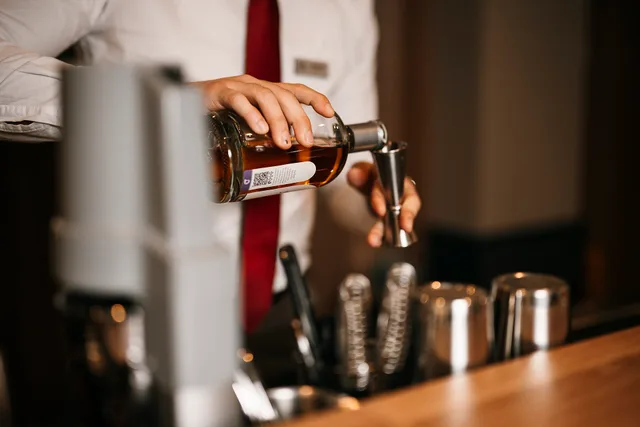
| Jigger | Barfly Japanese style | Accurate dilution at small volumes | Interior marks at small volumes |
| Carbonation | iSi Soda Siphon or a CO2 rig | The lift that makes a long drink read as a long drink | How the head and valve strip down |
What usually sits unused
Centrifuges, rotary evaporators and immersion circulators appear on equipment lists far more often than in daily service. They are real professional tools, and they are also the ones bought for a launch menu and then shelved. Count how many drinks on your list would use one every week before you commit.
Trade buyers make the same error with listings rather than equipment, which our notes on listing too wide set out.
Novelty glassware belongs in the same group. A drink built around a shape you own four of disappears on a busy night, and most bars quietly delist it rather than reorder.
Why cleanability is the first criterion
FDA materials on sanitation concerns with commercial deli slicers describe a failure mode that applies to any multi part food equipment.
If these machines are not properly cleaned and sanitized regularly, food soils can build up on surfaces. Disease causing microorganisms can also accumulate there and contaminate food.
The poster is meant to hang beside the machine because the problem areas are hard to see. A juicer, a carbonation head and a batch bottle share that structure. Anything with a seam, a gasket or a cavity you cannot see into deserves the same suspicion.
Hands are equipment too
CDC guidance on handwashing lists the key moments as before, during and after preparing food. It notes germs spread when people prepare drinks with unwashed hands or touch contaminated surfaces. Where soap and running water are unavailable, it recommends a sanitizer of at least 60 percent alcohol.
A bar plan should make sink placement an equipment decision, not a plumbing detail. The limits of sanitizer at a busy station without a reachable sink are set out in our stocking and hygiene checklist.
The wider operating context sits in our planning guide for alcohol free venues, and the preparation methods these tools serve are in our botanical preparation guide.
The verdict
Buy the scale, the press and the strainer first. They cost the least, get used every shift and improve every drink on the list.
Add carbonation once your long drinks have a settled recipe. A siphon is cheap; a CO2 rig with a regulator and a dedicated keg is not, and it only pays back if you pour carbonated drinks daily.
Skip the centrifuge, the rotovap and the dewar unless a named drink on your menu needs one weekly. If you are unsure, wait a quarter and count the times you would have reached for it.
Common questions
What is the first tool to buy?
The first tool is a 0.1 g scale. It turns guesswork into a repeatable recipe faster than anything else, and it costs less than a case of base spirit.
Is professional grade equipment worth it at home?
It is worth it only where the professional version dismantles more completely. A commercial press that separates fully beats a cheaper one that traps pulp in a seam.
How much carbonation equipment does a home setup need?
One reliable system. Consistency matters more than owning a siphon, a rig and a whipper.
When should a tool be replaced?
Replace it when it stops coming apart cleanly, or when a gasket no longer seats. Both are cleaning problems before they are performance problems.
In this guide
- Three checks before paying more for nonalcoholic bar gearThree checks for nonalcoholic bar gear: replaceable seals and parts, readable markings that measure true, and plain stainless over plating that wears through.
- Bar tool kit stocking: what to duplicate, what to spare, and cleaning ownershipHow to stock and maintain bar tools: what to duplicate, what spares to keep, who owns cleaning duties, and why surfaces carry contamination risks.
- Nonalcoholic bar equipment: four shifts, three to follow and one to skipA look at four equipment shifts for alcohol free bars: cheaper measuring tools, dismantlable designs, standard carbonation, and the appliances to skip.
- 4 things to check in nonalcoholic bar toolsFour checks for nonalcoholic bar tools cover yield, cleaning, batch repeatability and which jiggers, shakers and strainers keep working when the power goes.
- Nonalcoholic bar gear compared at home: yield, cycle time, and cleaningHome testers compared nonalcoholic bar gear for yield, cycle time, and cleaning so you can judge which zero-proof tools earn space in your kitchen.