Reviews
Part of Alcohol free drink mistakes: labels, storage and safety
Alcohol Free Drink Mistakes Storage: Four Common Errors
Avoid alcohol free drink mistakes storage rules can prevent: heat, light, refrigeration, and opened bottles can all affect flavor and safety.
Many alcohol free drink mistakes storage rules address are small, repeated, and mostly invisible until a drink tastes flat. A bottle stored badly is money already spent and flavor already lost. Four common errors account for much of it.
What to take away
- Heat and light are the two conditions that degrade these products fastest.
- Refrigeration slows growth. It does not stop everything, and some organisms grow cold.
- An opened bottle is not a sealed bottle, whatever the original shelf life said.
- The kitchen windowsill is the single worst storage location in most homes.
Mistake one: the sunlit shelf
Displaying bottles where they look good is an aesthetic decision with a chemical cost. Light and heat both accelerate reactions in the liquid.
FDA's questions and answers on benzene in soft drinks and other beverages give a specific illustration. Benzene can form at very low levels in some beverages containing both benzoate salts and ascorbic acid, and the guidance states that exposure to heat and light can stimulate that formation.
The same page gives the reassurance: the survey behind it found that almost all samples contained either no benzene or levels below 5 parts per billion, and concluded that the levels found do not pose a safety concern for consumers.
The practical reading is not alarm. It is that heat and light change what is in a bottle, and a cool dark cupboard costs nothing.
Mistake two: trusting the refrigerator to stop everything
Cold slows most microbial growth, so refrigeration works, but it does not stop all of it. FDA's guidance on preventing listeria infections notes that certain foods, including ready to eat refrigerated foods and unpasteurized milk, may carry Listeria. These bacteria can grow at refrigerator temperatures.
The same guidance notes infections can be serious for people who are pregnant, adults over 65, and people with weakened immune systems or chronic conditions.
For a drinks fridge, that means a refrigerated shelf is a slowing mechanism with a time limit, not a pause button, and spills get wiped rather than left. A venue batching fresh components works to a written holding rule, which our notes on what batching commits a bar to set out.
Mistake three: treating an opened bottle as shelf stable
The shelf life printed on a package describes the sealed product. Once opened, the clock is different and usually much shorter. This is the mistake that ruins the most syrups and aperitifs, because nothing looks wrong. Why a bottle can taste different on the second night without looking different is covered in our beginner's tasting notes.
Mistake three: opened bottle
- Write the opening date on every bottle.
- Decant to a smaller container once a bottle drops below half.
- Keep syrups and sugar heavy products refrigerated unless told otherwise.
- Finish live fermented products quickly, since they continue changing.
Mistake four: storing by category rather than by instruction
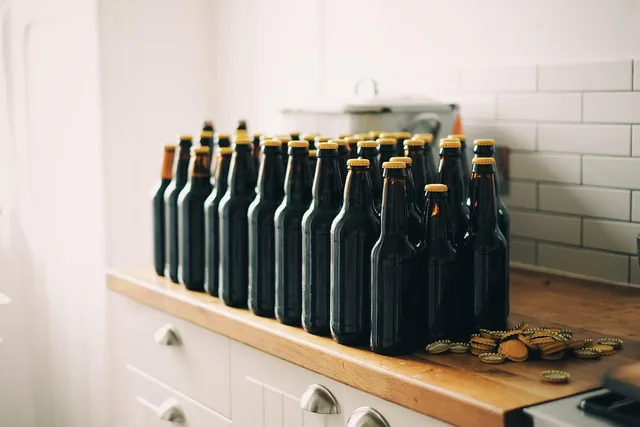
Bottles get grouped by what they look like. A shelf of tall dark bottles will contain products with completely different storage needs. Group by requirement instead: ambient sealed, ambient opened, refrigerated, and finish quickly.
This matters most for the bottles that move between groups. A shelf stable product becomes a refrigerated one the moment it is opened, and that is exactly when it usually gets returned to the shelf it came from, next to the sealed bottles it no longer resembles. Keeping a defined space for opened products removes the decision entirely.
The cost of getting this wrong is set out in our notes on storage as waste control, and the wider set of corrections is in the guide to avoiding common errors.